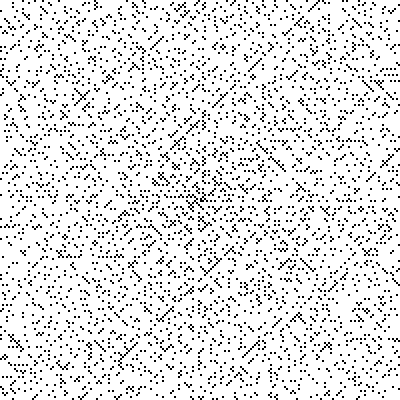
The Ulam spiral or prime spiral is a graphical depiction of the set of prime numbers, devised by mathematician Stanisław Ulam in 1963 and popularized in Martin Gardner's Mathematical Games column in Scientific American a short time later. It is constructed by writing the positive integers in a square spiral and specially marking the prime numbers.Ulam and Gardner emphasized the striking appearance in the spiral of prominent diagonal, horizontal, and vertical lines containing large numbers of primes. Both Ulam and Gardner noted that the existence of such prominent lines is not unexpected, as lines in the spiral correspond to quadratic polynomials, and certain such polynomials, such as Euler's prime-generating polynomial x2 − x + 41, are believed to produce a high density of prime numbers.Nevertheless, the Ulam spiral is connected with major unsolved problems in number theory such as Landau's problems. In particular, no quadratic polynomial has ever been proved to generate infinitely many primes, much less to have a high asymptotic density of them, although there is a well-supported conjecture as to what that asymptotic density should be.
Construction
The Ulam spiral is constructed by writing the positive integers in a spiral arrangement on a square lattice and then marking the prime numbers. In the figure, primes appear to concentrate along certain diagonal lines. In the 200×200 Ulam spiral shown above, diagonal lines are clearly visible, confirming that the pattern continues. Horizontal and vertical lines with a high density of primes, while less prominent, are also evident. Most often, the number spiral is started with the number 1 at the center, but it is possible to start with any number, and the same concentration of primes along diagonal, horizontal, and vertical lines is observed. Starting with 41 at the center gives a diagonal containing an unbroken string of 40 primes (starting from 1523 southwest of the origin, decreasing to 41 at the origin, and increasing to 1601 northeast of the origin), the longest example of its kind.
History
According to Gardner, Ulam discovered the spiral in 1963 while doodling during the presentation of "a long and very boring paper" at a scientific meeting.These hand calculations amounted to "a few hundred points". Shortly afterwards, Ulam, with collaborators Myron Stein and Mark Wells, used MANIAC II at Los Alamos Scientific Laboratory to extend the calculation to about 100,000 points. The group also computed the density of primes among numbers up to 10,000,000 along some of the prime-rich lines as well as along some of the prime-poor lines. Images of the spiral up to 65,000 points were displayed on "a scope attached to the machine" and then photographed.The Ulam spiral was described in Martin Gardner's March 1964 Mathematical Games column in Scientific American and featured on the front cover of that issue. Some of the photographs of Stein, Ulam, and Wells were reproduced in the column. In an addendum to the Scientific American column, Gardner mentioned the earlier paper of Klauber. Klauber describes his construction as follows, "The integers are arranged in triangular order with 1 at the apex, the second line containing numbers 2 to 4, the third 5 to 9, and so forth. When the primes have been indicated, it is found that there are concentrations in certain vertical and diagonal lines, and amongst these the so-called Euler sequences with high concentrations of primes are discovered."
Variants
Klauber's 1932 paper describes a triangle in which row n contains the numbers (n − 1)2 + 1 through n2. As in the Ulam spiral, quadratic polynomials generate numbers that lie in straight lines. Vertical lines correspond to numbers of the form k2 − k + M. Vertical and diagonal lines with a high density of prime numbers are evident in the figure. Robert Sacks devised a variant of the Ulam spiral in 1994. In the Sacks spiral, the non-negative integers are plotted on an Archimedean spiral rather than the square spiral used by Ulam, and are spaced so that one perfect square occurs in each full rotation. (In the Ulam spiral, two squares occur in each rotation.) Euler's prime-generating polynomial, x2 − x + 41, now appears as a single curve as x takes the values 0, 1, 2, ... This curve asymptotically approaches a horizontal line in the left half of the figure. (In the Ulam spiral, Euler's polynomial forms two diagonal lines, one in the top half of the figure, corresponding to even values of x in the sequence, the other in the bottom half of the figure corresponding to odd values of x in the sequence.)